What happens when the war in Ukraine is over? For many Ukrainian and European actors, the answer is self-evident: if the war ends, Ukraine should take its place among its European neighbours and join the European Union as soon as possible. But little attention is generally given in Europe to Ukrainian internal political affairs. In order to have a European future, Ukraine needs to implement a series of reforms, but it is struggling to do so because of a complex internal political situation, which exposes serious institutional weaknesses within Ukraine’s parliament and poses major challenges for President Volodymyr Zelenskyy and his governing party, Servant of the People.
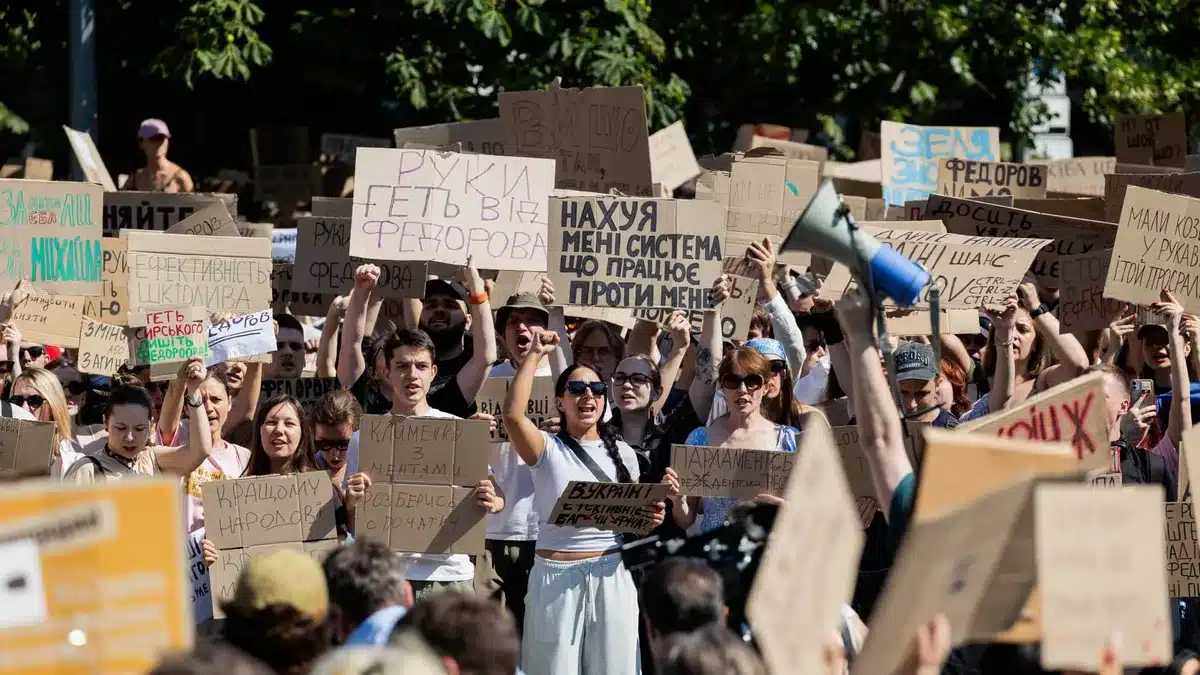
The recent political crisis surrounding Zelenskyy’s government has made these problems even more visible. The reshuffling of the government, and particularly the controversy surrounding the departure of Defence Minister Mykhailo Fedorov, has demonstrated that Ukraine’s political difficulties extend beyond the relationship between the presidency and parliament. Tensions within the executive itself, including disagreements over the functioning of the Defence Ministry and the military leadership, have added another layer to an already fragile political system.
The Fedorov affair is particularly relevant in this context. Regardless of the reasons behind his departure, the controversy has exposed the difficulties Zelenskyy faces in maintaining political cohesion while simultaneously managing a prolonged war. It also raises broader questions about the balance between strong presidential leadership, institutional independence and political accountability. What is going on in Ukraine? And what does the country’s current political instability mean for its future after the war?
Background
Ukraine is a country torn by war. When the war ends, estimates suggest that the costs of post-war reconstruction and recovery could become the most extensive in modern history. The EU candidate status Ukraine gained in 2022 provides the country with an institutional framework it could and should follow when it commences its reconstruction efforts. But in the meantime, during and after the war, it is incredibly challenging for Ukrainian authorities to adopt policies that meet EU accession standards in full. The internal political situation has complicated that process even further. In theory, incumbent President Volodymyr Zelenskyy governs the country with a supermajority in parliament: his Servant of the People party occupies 228 of the 450 seats in the Verkhovna Rada. Nevertheless, his majority has shown itself to be fragile. Over the past year, a parliamentary crisis has broken out in the Rada, exposing broken relations between Zelenskyy’s President’s Office and the Cabinet on the one hand, and Zelenskyy’s own Servant of the People MPs on the other. A perceived lack of communication and cooperation between the government and parliament has led to growing disillusionment. More recently, the crisis has also moved into the executive branch. The reshuffling of Zelenskyy’s government and the controversy surrounding Defence Minister Mykhailo Fedorov have highlighted the extent to which political disagreements and institutional tensions are no longer limited to parliament. The Fedorov case has become a particularly visible example of the broader difficulties facing Zelenskyy’s administration as it attempts to maintain unity during wartime.
A Fragile Parliamentary Majority
In the Kyiv Independent, political analyst Volodymyr Fesenko estimated that the “core” of Zelenskyy’s parliamentary faction – those who can be relied upon to vote in favour of the government – had fallen to approximately 150 to 175 members. Zelenskyy’s lack of control became awkwardly visible as parliament repeatedly failed to pass legislation required to unlock billions of dollars in loans from both the EU and the International Monetary Fund (IMF). Such funds from the EU and IMF are provided conditionally, when institutional and economic reform standards are met. One could assume that this implies that almost all Ukrainian politicians would naturally push for such reforms. However, some measures designed to de-shadow the Ukrainian economy and bring the Ukrainian market into line with European standards are incredibly unpopular, such as new taxes affecting self-employed entrepreneurs, of whom the country has many. Many small businesses, of which a large number are registered as self-employed, could be pushed back into the shadow economy and stop paying taxes altogether. Ukrainian lawmakers therefore hesitate to approve such measures, creating a conflict between the reforms demanded by international partners and the political realities faced by MPs at home.
After Zelenskyy’s Chief of Staff Andriy Yermak resigned in November, the degree of discipline among parliamentarians decreased dramatically. Yermak resigned after a major corruption scandal, which led to a significant reshuffle in Zelenskyy’s cabinet. According to Kyiv Independent journalist Oleg Sukhov, the whole political system under Zelenskyy’s government was heavily dependent on Yermak’s influence. Yermak functioned as a kind of “bogeyman”, securing that MPs voted the right way through pressure, threats and blackmail. His successor, Kyrylo Budanov, appears not to have had enough experience in domestic politics to maintain the same level of control over members of parliament. Although one could argue that it is a positive development that parliamentarians are no longer being intimidated by the President’s Office, the current lack of communication and cooperation between parliament and government clearly is not. This has exposed a fundamental weakness in Ukraine’s political system: political discipline appears to depend more on personal influence than on strong institutions and party structures.
From Parliamentary Tensions to the Fedorov Crisis
The recent crisis surrounding Defence Minister Mykhailo Fedorov illustrates that these institutional weaknesses extend beyond parliament.
Fedorov’s departure from the government, amid tensions surrounding the functioning of the Defence Ministry and its relationship with Ukraine’s military leadership, has created a new political controversy for Zelenskyy. The affair has been particularly sensitive because Fedorov had become associated with technological innovation and the modernisation of Ukraine’s defence capabilities.
The controversy also illustrates the difficult position in which Zelenskyy finds himself. As president and wartime leader, he is expected to ensure that the government and military leadership function effectively. At the same time, decisions to remove senior officials can create the impression of an increasingly centralised political system in which institutional disagreements are ultimately resolved through presidential intervention.
The Fedorov case should therefore not be viewed in isolation. It is another example of the broader institutional tensions that have become visible in Ukraine’s political system. The same underlying problem can be seen in the relationship between parliament and government: institutions that should cooperate often appear unable to resolve disagreements through stable and predictable political mechanisms.
Servant of the People
An additional possible explanation for the current parliamentary crisis might be found in the institutional weaknesses of Ukraine’s political culture, as is evident from the example of Zelenskyy’s party, Servant of the People. In the past decades, political parties in Ukraine have primarily functioned as vessels for individual politicians and their own ambitions, rather than as long-established institutions with an established ideological foundation and a long history. Servant of the People is no exception to this: it was registered in 2018 and has only a few hundred members nationwide. The party has primarily run on a platform of valence populism, meaning that it has not aligned itself with a consistent political ideology but has campaigned on widely approved issues such as anti-corruption and democratic reform.
The Kyiv Independent’s Oleh Sukhov has stated that Servant of the People parliamentarians are generally tired. They were not expecting to serve in parliament indefinitely under martial law, and many of them lack political experience. Furthermore, many are dissatisfied with the way Zelenskyy is fulfilling his promises. Zelenskyy’s hesitation to submit reforms that can actually count on parliamentary support has led to mistrust, as is the case with propositions to make the prosecutor-general a neutral figure, diminish political control over the State Bureau of Investigation and clean the Supreme Court of tainted and discredited judges.
Zelenskyy’s unpopularity does not help his case. According to an Ipsos survey from January this year, almost 50% of Ukrainians distrust the President’s Office, while about 30% would reject voting for Zelenskyy if elections were held at that moment. Although Zelenskyy’s popularity has been worse – it was at almost rock bottom before the war, and a “rally around the flag” effect benefits his popularity – a re-election after the war seems uncertain. A peace deal with clear Ukrainian gains over Russia could benefit Zelenskyy’s chances, but this is highly speculative. A peace deal could also include compromises and losses that Ukrainians might interpret as treason, which could have the opposite effect.
Political Parties Without Strong Institutional Roots
As many MPs for Servant of the People are relatively new politicians with little political experience prior to their election, there is a risk that they have not developed as strong a connection to the party as an institution and to its ideology as would be desirable for a large governing party.
As Zelenskyy continues to struggle with corruption scandals, such as those surrounding the state nuclear monopoly Energoatom, his chances of eventual re-election after the war may become increasingly uncertain. His current lawmakers may anticipate this and begin distancing themselves from his government. This dynamic could help explain why parliamentary discipline has weakened. If MPs do not believe that the current governing party will remain the dominant political force after the war, they have fewer incentives to remain loyal to the president. Important for understanding the fragmented dynamic of Ukrainian politics is the role and extreme unpopularity of the opposition parties, often led by major political figures such as Zelenskyy’s predecessor, former president Petro Poroshenko.
Although the introduction of martial law after the full-scale Russian invasion in 2022 has led to a kind of unilateral consolidation in the Verkhovna Rada – especially since the pro-Russian Opposition Platform – For Life party was banned – some forms of political opposition remain, albeit ineffective and fractured.
The two most prominent traditional opposition figures remain Zelenskyy’s fierce rival Poroshenko and former prime minister Yuliia Tymoshenko, who helped lead the Orange Revolution in 2004.
Poroshenko is still in charge of European Solidarity, which has existed since 2000 as his personal political outlet. European Solidarity lacks a clear ideology, like many Ukrainian parties; according to its own programme, it advocates pragmatism and realism. Poroshenko’s presidency between the Euromaidan revolution and 2019 has widely been considered disappointing, as he failed to move away from political clientelism. After losing the 2019 elections, his political position was damaged even further. He presented himself as more patriotic and pragmatic than Zelenskyy and portrayed himself as someone who could make concessions to Russia. That strategy backfired after the 2022 full-scale invasion.
According to Ipsos, only a small percentage of Ukrainians would regard Poroshenko as their first-choice candidate for future presidential elections, while a much larger share rejects him. For Yuliia Tymoshenko, the figures are even worse. Like Poroshenko, Tymoshenko is still largely identified with the highly personalised, oligarchic and elitist political culture that Ukrainians definitively rejected with Zelenskyy’s election in 2019.
The liberal Holos (“Voice”) party was elected as a small faction with 20 seats in 2019 as a hopeful, refreshing force advocating anti-corruption legislation. Holos proposed more stringent checks on corruption than Servant of the People and aligned itself internationally with the Alliance of Liberals and Democrats for Europe (ALDE). Holos thus became the first party with a liberal ideology to enter the Ukrainian parliament. Its leader, Kira Rudyk, even became vice president of ALDE. The party, however, fell apart in 2021, when ten of its parliamentarians dissented amid frustration over a vote concerning Ukrainian-language quotas. Holos now has only nine loyal MPs left.
As of today, it remains unlikely that any of these opposition parties will rise to the surface as major contenders in future parliamentary elections. Given Ukraine’s political culture and the likely dramatic reshaping of the political landscape after the war, new political forces – perhaps led by prominent war figures such as former army general Valerii Zaluzhnyi – may take the stage. Active political opposition against the Zelenskyy presidency and his ruling party is also unlikely to take on large proportions while the war continues. Pushing oneself forward while Ukraine is still undergoing massive Russian attacks is generally regarded as a signal of disunity and could therefore amount to political suicide.
The institutional weaknesses within Servant of the People and the situation of the fragmented, unpopular and powerless opposition are not isolated examples in Ukrainian political history. As mentioned above, Ukrainian political parties have primarily functioned as vessels for individual politicians, and the lack of a healthy, pluralistic political culture can continue to be a source of instability in the future.
The recent crisis surrounding Zelenskyy’s government, and particularly the controversy over Mykhailo Fedorov, reinforces this concern. What began as a parliamentary crisis has increasingly become a broader question about the functioning of Ukraine’s political institutions. The difficulties between government and parliament, combined with tensions within the executive and the defence establishment, demonstrate how dependent Ukraine’s political system remains on individual personalities and personal relationships.
Those who are considered among Zelenskyy’s main potential opponents for the future presidency – including former army general Valerii Zaluzhnyi and other prominent figures – are not necessarily affiliated with established political parties. They could therefore form new political movements if they were to run for office.
In a country struggling with massive, society-wide problems such as war, poverty, corruption and reconstruction, it is unlikely that a modern political culture based on strong ideological traditions will emerge in the near future. The valence populism on which Zelenskyy built his candidacy is not likely to disappear from Ukrainian politics anytime soon.
The instability in the Ukrainian parliament is a serious risk to Kyiv’s EU membership agenda. Ukraine’s European future depends not only on military survival or economic reconstruction, but also on its ability to implement the institutional reforms required for membership. That requires a functioning parliament, an effective government and strong political institutions. But for that to happen, strong political leadership alone is not enough. Ukraine also needs strong institutions capable of surviving changes in leadership, political disagreements and the pressures of wartime. The crisis surrounding parliament, the government and now figures such as Fedorov shows precisely how difficult that remains for now. The ultimate test for Ukraine will come after the war. The country will have to decide whether the political system built during wartime can evolve into a more stable, pluralistic and institutionally resilient democracy. If it cannot, the political deadlock of today may become one of the greatest obstacles to Ukraine’s European future tomorrow.