Written by Duko Goedegebuure
Since the partial collapse of a recently renovated railway station in Novi Sad, public anger has been growing in Serbia and shows no sign of abating. Led by students, Serbians have been taking to the streets for almost two years, demanding accountability for the accident. In the aftermath of the collapse and the protests, President Vučić has resigned and elections are approaching. The mobilisation of dissatisfied voters is enormous. The students are contesting these elections with their own list and are supported by most opposition parties.
Ahead of the Serbian elections on 25 October, PRO International is publishing a three-part series asking whether Serbia is moving back towards democracy, or whether Vučić has already reshaped the rules of the game so thoroughly that Serbia is drifting further towards autocracy. In part two, we explain the student list’s strategy and the choices made by other opposition parties about whether or not to rally behind it.
Studentska lista
Over the past two years, the students have mobilised hundreds of thousands of Serbians. Ahead of the elections, the students drew up their own list of candidates and are taking part in the elections. Jelena Vasiljević, a researcher at the University of Belgrade, said that the list consists of people from different (ideological) backgrounds. According to Jelena, the students have succeeded in turning the upcoming elections into a referendum on Vučić and his regime. By putting forward a diverse list, the student list hopes to win the support of as many Serbians as possible in its fight against the regime.
According to Jelena, the strategy is simple: “win the elections”. She explained that this is “the first time in a long while that Serbia has had a strong group capable of breaking Vučić’s hold on power”. The enormous mobilisation of recent years must now be converted into votes and seats in the upcoming elections.
The students also made a demand of Serbia’s opposition parties: they should not contest the elections independently, but should support the student list. By far the majority of opposition parties have complied with this demand. However, two party coalitions—“European Serbia” and “NADA”—are contesting the elections independently, alongside the governing parties and several minority lists.
Different parties, different strategies
The SSP is one of the parties participating independently as part of the “European Serbia” coalition. Nevertheless, according to Konstantin Samofalov, former member of parliament and international secretary of the SSP, it “has the same fundamental goal as the student list: to defeat Vučić’s undemocratic and anti-European government”. He explained that the party believes Serbian voters should have the option of choosing an explicitly pro-European party. According to him, EU membership is Serbia’s number-one priority. The party has, however, indicated that it wants to cooperate with the student list after the elections.
The Green-Left Front (ZLF) has made a different assessment. According to political activist Andrej Zlatović, it would be a red flag for a party that itself emerged from a protest movement not to support the student list. Another important reason, according to Andrej, is that Serbia needs change. The ZLF wanted to show that people are capable of creating change and that a decisive victory over Vučić is possible.
Ksenija Marković, a politician representing the Democratic Party (DS), explained it as follows: “We support the student list because democratic change is more important than our party interests. If we had run ourselves, we would have weakened the student list.” According to Marković, the DS strategy is to support the broadest possible social and democratic alternative—in this case, the student list.
Between hope and fear
None of the people PRO International spoke to ahead of Sunday considers the elections fair or free, but they all agree that the elections will be hugely significant for Serbia. Andrej Zlatović of the ZLF, for example, fears “that Serbia will end up in a Russia-like situation if Vučić wins another term”.
Despite the unfair contest—for example, in terms of the country’s media environment—the parties are hopeful about the elections, even as they face the governing SNS. The student protests have mobilised unprecedented numbers of Serbians. More election observers than ever before will be monitoring the vote and protecting the opposition’s votes on election day. And although opinion polls differ and are not very reliable, some even indicate that Vučić could lose his majority.
There are, however, also differences in expectations, particularly regarding what will happen after the elections. Some expect the aftermath to involve considerable violence and believe Vučić will not concede defeat easily. Others expect that, like Viktor Orbán in Hungary, Vučić will have to acknowledge his defeat, albeit reluctantly.
Victory will only be the beginning
For many Serbians, more is at stake on Sunday than the election result alone. After years of democratic decline, political change seems within reach for the first time. But even if the student list succeeds in defeating Vučić, a second struggle will begin afterwards: restoring democratic institutions and the rule of law.
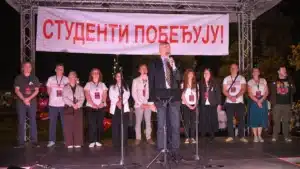
Whether the student list can make its slogan, “Students Win!”, a reality despite electoral fraud and political interference will become clear on Sunday, 25 October.
In the third and final instalment of this series, we analyse the election result and what it means for Serbia’s democratic future.