Written by Duko Goedegebuure
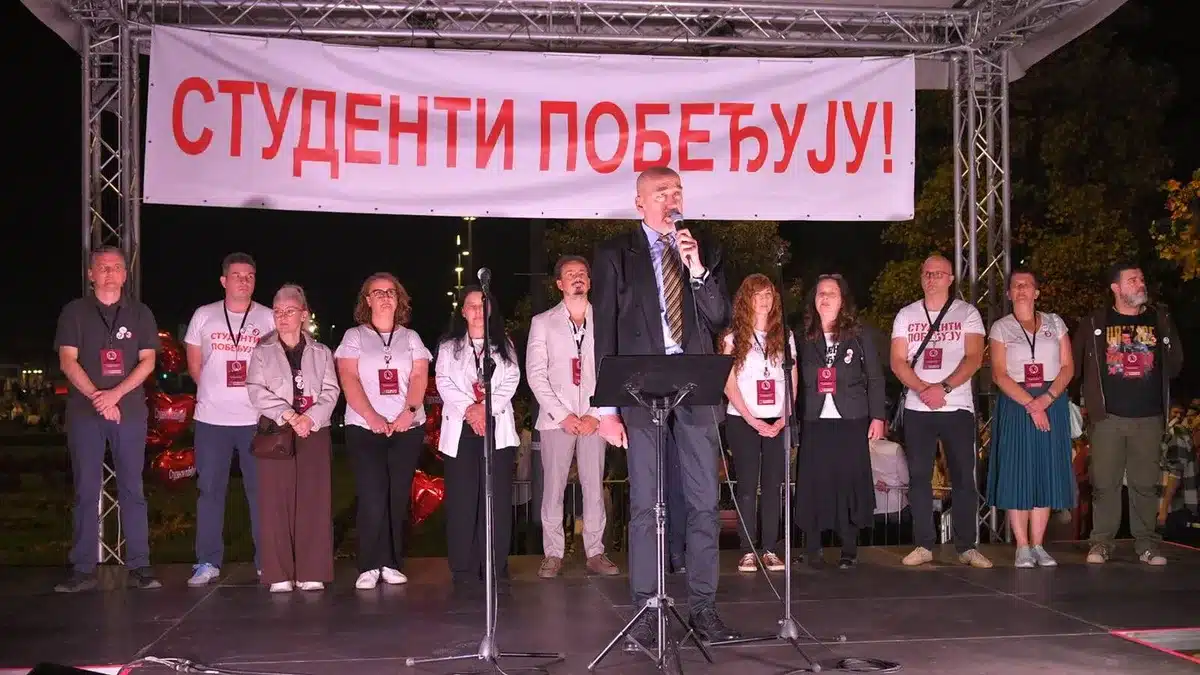
Photo: Election rally of the “Studentska lista – Studenti pobeđuju” (Student List – Students Win) in Serbia, ahead of the snap parliamentary elections.Photo source
Suddenly, events unfolded rapidly on Sunday evening. At around 9:30 p.m., Aleksandar Vučić announced that his party had lost the elections and that the student-led list had secured a majority in the Serbian parliament. Celebrations erupted in the streets of Belgrade. After nearly two years of mass protests against corruption, repression and democratic backsliding, the students had succeeded in defeating the regime.
In the third and final part of this series, we analyse the historic electoral victory of the student-led list. How did a peaceful protest movement manage to bring about political change after years of democratic backsliding? And what does this victory mean for the future of Serbia and other protest movements?
From the Streets to Parliament
According to the preliminary election results, the student-led list secured nearly 54 percent of the vote, winning 141 of the 250 parliamentary seats. Vučić’s SNS won 103 seats with approximately 40 percent of the vote. This landslide victory marks the end of years of political dominance and repression under the regime.
Voter turnout was exceptionally high, reaching approximately 69 percent. Never before had so many Serbian citizens turned out to vote. In reality, turnout was even higher, as the electoral registers are outdated. It is inspiring to see how the students managed to mobilise young people and citizens who had previously lost confidence in politics and the possibility of change, encouraging them to cast their votes.
A Nonviolent Movement
Even after nearly two years of repression, intimidation and political pressure, the student movement managed to remain committed to peaceful resistance. Vučić’s government attempted to suppress and discredit the protest movement in various ways. Peaceful demonstrators were arrested and detained, critical professors had their salaries withheld, and the students were portrayed negatively in government-controlled media.
Nevertheless, the students remained committed to their peaceful strategy. Rather than responding with violence, they continued to demonstrate, gradually mobilising an increasing number of Serbians. In doing so, they prevented the regime from using violence as a justification for further suppressing the protests.
It was precisely this peaceful persistence that proved to be one of the student movement’s greatest strengths. By refusing to give in to Vučić’s provocations, the students managed to maintain their credibility. As a result, they gained growing support across broader sections of Serbian society.
The Difficult Road Ahead
Nevertheless, Vučić’s departure does not mean that Serbia will become a fully functioning democracy overnight. After years in which the ruling party consolidated its control over state institutions, the judiciary and the media, the student-led list faces an enormous challenge. Poland and, more recently, Hungary have already demonstrated how difficult this process can be in practice.
Restoring independent institutions, tackling corruption and strengthening the rule of law will take time. Moreover, the student-led list consists of candidates with diverse political convictions. While they have so far been united in their opposition to Vučić, they will now have to make collective decisions about Serbia’s future.
In addition to forming a government and appointing a prime minister, the student-led list will soon face another major test: a new president must also be elected by 25 December 2026.
A Movement That Inspires?
The significance of these elections may extend far beyond Serbia’s borders. In a world where democratic backsliding is taking place in an increasing number of countries, the student-led list has demonstrated that democratic change remains possible.
Despite provocations, police violence and smear campaigns, the students in Serbia continued their peaceful resistance. By standing up against corruption and fighting for a democratic future, they gradually gained increasing support. Ultimately, like Péter Magyar, the student-led list has shown that even in an electoral autocracy, democratic change is still possible.
In countries such as Albania and Georgia, young people have also recently taken to the streets in large numbers to protest against corruption and political leaders. Although the political circumstances differ, the victory in Serbia could serve as an important source of inspiration for these movements, and perhaps even as a blueprint for change.
The first step has been taken. Whether the student-led list will succeed in transforming Serbia into a fully functioning democracy remains to be seen. But for now, the election results in the Western Balkans offer a reason for hope.


