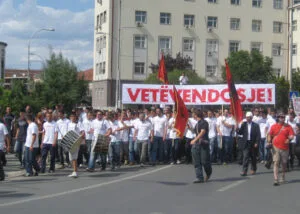
Source: Wikimedia Commons
For more information you can watch the webinar: Kosovo at the Ballot Box: Expectations for the 2025 Snap Elections
Introduction
Kosovo held snap parliamentary elections on 28 December 2025, the second general election in less than a year, in an attempt to resolve a prolonged institutional and political deadlock that followed the February parliamentary vote. The December elections resulted in a strengthened mandate for the ruling Vetëvendosje (LVV), led by Prime Minister Albin Kurti, but once again stopped short of delivering an outright parliamentary majority.
While the vote clarified the balance of political forces, it did not fully eliminate the challenges of government formation. Instead, it reshaped the negotiating environment in which Kosovo’s next government will be formed.
Political background
The snap elections were the direct consequence of the failure to form a stable government after the February 2025 parliamentary elections. Although LVV emerged as the largest party in that vote, it lost its previous governing majority and faced unified resistance from opposition parties unwilling to enter a coalition under Kurti’s leadership.
As a result, Kosovo experienced months of institutional paralysis. The Assembly repeatedly failed to elect a speaker, blocking the formation of parliamentary committees and preventing a confidence vote on a new government. Kurti continued to govern in a caretaker capacity, with limited authority and a constrained legislative agenda.
The deadlock carried both domestic and international costs. Kosovo was unable to pass its 2025 budget on time, while several international financing agreements, including EU- and World Bank–linked funds, remained unratified. International partners increasingly voiced concern that political dysfunction was undermining Kosovo’s reform agenda and its European aspirations.
Against this backdrop, President Vjosa Osmani dissolved parliament in November 2025 and called snap elections, arguing that only a renewed mandate could restore institutional functionality.
Campaign
The December campaign unfolded under the shadow of political fatigue. Voters were asked to return to the polls less than a year after the previous election, amid frustration over stalled governance and economic uncertainty.
LVV framed the election as a choice between continuity and obstruction, arguing that the February results had been insufficient to overcome entrenched opposition and that a stronger mandate was needed to govern effectively. Kurti emphasised anti-corruption measures, social policies, and political independence from traditional power structures.
Opposition parties, notably the Democratic Party of Kosovo (PDK) and the Democratic League of Kosovo (LDK), focused their campaigns on Kurti’s leadership style, accusing him of deepening political polarisation and failing to compromise after the February vote.
While relations with Serbia and Kosovo’s international positioning remained present in the debate, the campaign was dominated by questions of governability, institutional responsibility, and political stability.
Results
Kosovo’s Assembly consists of 120 members, elected through open-list proportional representation in a single nationwide constituency. Of these seats, 20 are reserved for minority communities, including 10 for Kosovo Serbs, with the remaining seats allocated to other non-majority groups.
A simple majority of 61 seats is required to elect a government.

Source: ElectsWorld
The elections produced a clear winner but not an absolute majority.
Vetëvendosje (LVV): approximately 51% of the vote, translating into around 57 seats
PDK: approximately 20%, 22 seats
LDK: approximately 13–14%, 15 seats
Alliance for the Future of Kosovo (AAK): approximately 5–6%, 6 seats
Minority parties: 20 reserved seats
Compared to February 2025, LVV significantly increased both its vote share and seat total, consolidating its position as Kosovo’s dominant political force. The traditional centre-right parties continued to lose ground, reflecting longer-term shifts in Kosovo’s political landscape.
Turnout stood at just under 50%, reflecting both electoral mobilisation around the promise of stability and lingering voter fatigue.
Government formation: current situation
As of early 2026, the focus has shifted to institution-building and coalition negotiations. The formal process begins with the certification of results, followed by the convening of the new Assembly and the election of its leadership.
Although LVV remains short of an outright majority, its strengthened position fundamentally alters the dynamics of government formation compared to earlier in 2025. Rather than attempting to construct a broad coalition with major opposition parties, LVV is widely expected to seek support from:
- Non-Serb minority representatives, whose reserved seats can help bridge the gap to 61 votes;
- Smaller parliamentary groups or individual MPs willing to provide confidence-and-supply style support.
Opposition parties have so far reiterated their unwillingness to join a formal coalition but have avoided blanket obstructionism, particularly on votes related to institutional functioning and international obligations.
Importantly, the December results reduce the likelihood of a repeat of the post-February paralysis. While negotiations remain necessary, a more streamlined and faster government formation process is more probable.
Outlook
The December snap elections appear to have stabilised Kosovo’s political trajectory without fully resolving it. LVV’s enhanced mandate places it in a strong position to form a government, but the durability of that government will depend on maintaining parliamentary support beyond the initial confidence vote.
In the short term, priorities include passing the budget, ratifying delayed international agreements, and restoring legislative normalcy. In the medium term, the government’s ability to translate electoral dominance into effective governance will shape Kosovo’s domestic stability and its relations with international partners.
A key test for the new Assembly will be the election of Kosovo’s next President. Under Kosovo’s constitutional framework, a presidential candidate must receive a two-thirds majority (80 of 120 votes) in the first two rounds of parliamentary voting to be elected. If no candidate reaches that threshold, a third round is held between the two leading candidates, and a simple majority (61 votes) is sufficient to elect the President; if that also fails, the Assembly can be dissolved and new elections called. This multi-round procedure is designed to encourage broad cross-party support for the head of state, beyond narrow majorities in parliament, meaning LVV will have to work together with other parties, and elected members to choose a new President.
Whether the December elections mark the end of Kosovo’s political deadlock, or merely a pause in it, will become clear in the first months of the new Assembly.
Written by Elene Amiranashvili