Kosovo’s political crisis shows no sign of stopping. As the Kosovan parliament failed to elect a new President in four months after the last elections, new snap elections are called on the 7th of June – the third parliamentary elections in one and a half years. What causes the constant political turmoil? And what does its future look like?
Three questions and answers with Donika Emini, research fellow at the University of Graz, and member of the Balkans in Europe Policy Advisory Group.
Written by Jens Bosman | 13-05-2026
Ms. Emini, the piece you wrote on our website on Kosovo’s last parliamentary elections in December was titled ‘From Deadlock to Dominance’ – with an end to Kosovo’s ‘political paralysis’ broadly expected, following Vetëvendosje’s landslide victory. What happened between then and now: why couldn’t parliament agree on a presidential candidate, and who is ‘to blame’, if at all?
“The title of my piece reflected a genuine moment of democratic exception. Vetëvendosje’s victory, with a vote share over 51 percent in a multiparty system, was rightly interpreted as a potential turning point after almost a year of political crisis following the inconclusive February 9 2025 results. The result was seen as an opportunity for institutional stabilisation, policy continuity, and a break from Kosovo’s long cycle of fragile, short-lived governments. For the first time since independence, a party had now twice secured a strong and unambiguous electoral mandate, and the expectations for political stability were well-founded.
What followed, however, was not consolidation, but a deepening of the crisis – this time centred not on the government or parliament, but on the presidency, which requires a broader coalition [80 of 120 votes in parliament, red] to elect. The problem was no longer the absence of a mandate to govern. Vetëvendosje had that. The problem was the inability to translate it into functional governing structures. What emerged was a paradox: Kosovo’s most electorally legitimate result since independence coinciding with some of its deepest institutional impasses.
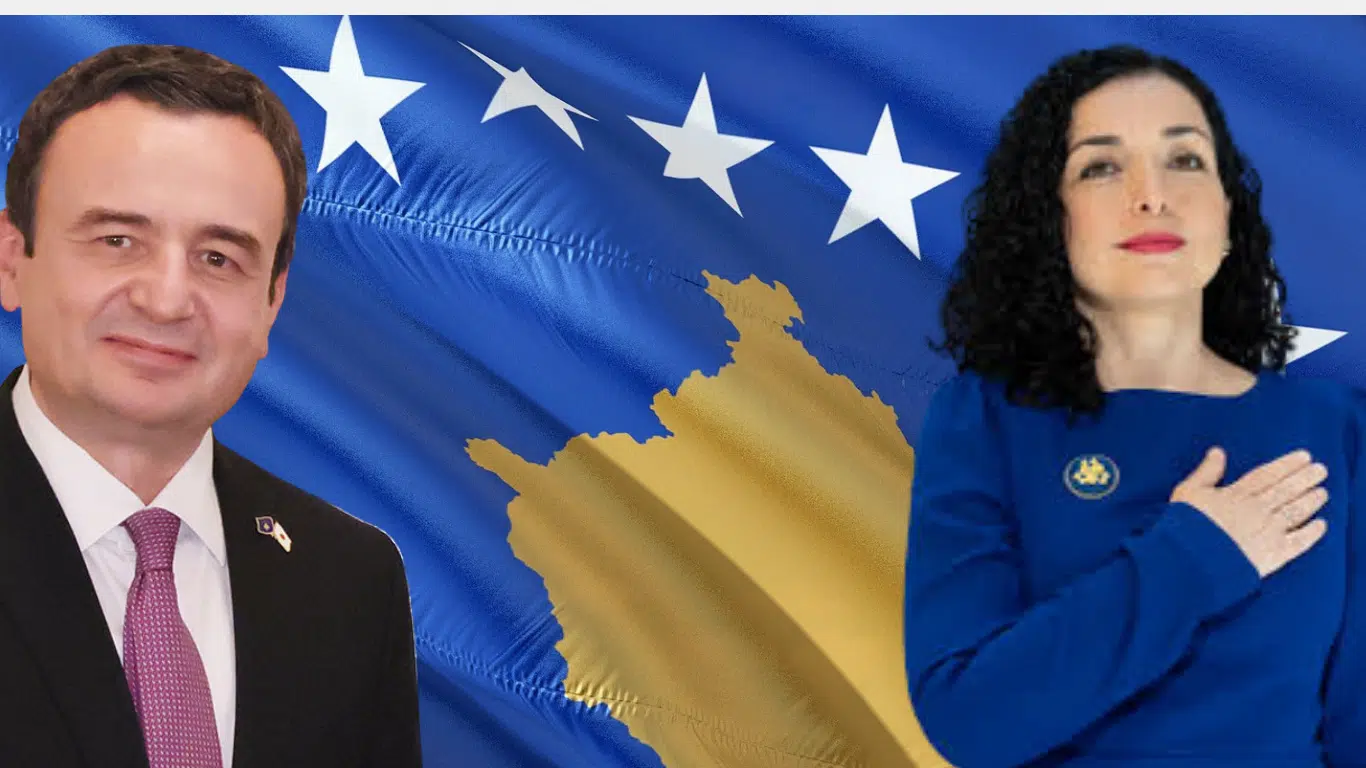
At the heart of this lies the fallout between Albin Kurti [Vetëvendosje’s leader, red.] and Vjosa Osmani [Kosovo’s former President, red.]. Their 2021 alliance had been built on an implicit understanding of complementarity: Kurti as prime minister, Osmani as president, each reinforcing the other’s position. That arrangement unravelled over deepening disagreements, particularly on foreign policy. When the moment came for Kurti to support Osmani for a second term, he declined, transforming a functioning partnership into one of Kosovo’s most consequential political rivalries, and leaving the question of a presidential successor entirely unresolved. Vetëvendosje, despite holding over 60 seats, still fell short of the 80-member quorum required to elect a president. Rather than pursuing a genuine consensus candidate, it offered other parties a transactional, one-time cooperation on its own terms, which the opposition rejected.

The structural reasons run deeper still. Kosovo’s constitutional architecture, shaped by the Ahtisaari Plan, was deliberately designed to require broad consensus on the presidency as a safeguard against the concentration of power. In practice, those mechanisms have been captured by a zero-sum logic in which the goal is not to govern better but to prevent the other side from functioning. The opposition weaponised quorum requirements and boycotts, not as instruments of accountability, but as veto tools. By refusing to engage meaningfully or propose alternatives, the opposition also weakened its own credibility.
Yet Vetëvendosje bears its share of responsibility too. Having secured the most comfortable majority a party could realistically hope for in Kosovo’s multiparty system, it chose to approach compromise conditionally and strategically, using dialogue more to expose rivals than to reach agreement. The result is a mutual barricading dynamic in which the opposition blocks because it is one of the few tools it has left, and the governing party tolerates the crisis because early elections continue to suit its interests.
So if the question is who is to blame, the answer is everyone, and the system itself. Kosovo is not suffering from a single miscalculation. It is the product of a political culture that has systematically confused electoral legitimacy with governing capacity, and opposition with obstruction. No actor bears sufficient cost for institutional failure, and so the incentive structure continues to reward blockage over compromise. That is the deeper problem, and no election alone will fix it.
How does the internal political crisis affect Kosovo’s position and credibility on the international level? Are some consequences already being felt?
This prolonged instability is causing serious, compounding damage to Kosovo’s international standing, and the consequences are no longer merely reputational. They are measurable and, in some cases, already irreversible in the short term.
The most immediate and damaging signal is what Kosovo’s institutional paralysis communicates to its international partners. Every month of caretaker government, every dissolved parliament, every missed deadline transmits a clear message about Kosovo’s reliability as a political interlocutor. Partners who might otherwise engage more deeply become reluctant to do so when they cannot identify a stable and continuous counterpart on the other side. Sustained international engagement requires continuity, and continuity requires functional institutions. Kosovo, governed by a caretaker executive with no parliament and no president, is structurally incapable of meeting that requirement.
The costs are most visible and most painful in the relationship with the European Union. The EU’s Growth Plan for the Western Balkans represents the most significant financial and political opportunity Kosovo has had since independence, with over 800 million euros tied directly to a reform agenda. Kosovo has completed none of the reform steps required to access it. Not one. This is not solely a consequence of the current caretaker situation. It reflects a governing failure that predates the latest electoral cycle. But the timing could not be worse: the EU’s punitive measures were only recently lifted, opening a genuine window for deeper political engagement and advancement of Kosovo’s European agenda. Kosovo is squandering that window at precisely the moment it opened.
Beyond finances, this situation actively fuels narratives opposing Kosovo’s statehood and international recognition. Opponents of Kosovo’s independence no longer need to make a sophisticated legal or political argument – they just have to point to the crisis itself. Internal dysfunction becomes an instrument in the hands of Kosovo’s adversaries, used to question the country’s maturity and its capacity for genuine self-governance. This is one of the most underestimated dimensions of the problem: domestic political failure carries direct geopolitical costs.
And perhaps most critically, at a moment when the broader geopolitical landscape is shifting rapidly, when Western attention is stretched, alliances are being renegotiated, and small states need to be more strategic and proactive than ever, Kosovo risks becoming progressively less relevant. Not because the world has turned against it, but because it lacks the institutional bandwidth to be consistently active and present in advancing its own agenda. Kosovo is burning what little political capital it has left on crises of its own making, narrowing the space for the kind of political risk-taking that its international consolidation actually requires.
The consequences are severe and underappreciated. This is not a question of image management. It is a real and compounding political, economic, and strategic cost that keeps the country in a state of limbo at precisely the moment when it should be consolidating its gains and moving forward.

New snap elections are already coming up in June. What are your expectations for the result and aftermath? Will the PDK & LDK’s strategy to block Vetëvendosje prove to be successful in order to recover from December’s result, or will Vetëvendosje retain its dominance? And what is to be expected from former President Osmani?
Kosovo is approaching its third general election in less than sixteen months with no structural reason to expect a fundamentally different outcome. The same political actors, the same polarisation, and the same constitutional architecture, and in all likelihood some version of the same impasse. That is the sobering starting point for any honest assessment of what the June election holds.
The most significant development since December is the repositioning of the opposition. LDK has officially embraced Vjosa Osmani back into the party [Osmani broke with the LDK in 2021, red.], and the two are preparing to run together, a configuration that attempts to recreate in some ways the dynamic of 2021, when Osmani’s alignment with Kurti helped produce Vetëvendosje’s historic result. In that sense, the opposition is trying to use against Kurti the same formula he once benefited from. However, the political circumstances are fundamentally different, and the formula is unlikely to produce the same effect in reverse. The PDK, meanwhile, has been working to reorganize and expand, but so far has been the least active party in terms of bringing new membership or introducing a new niche.
The central and structural problem for the opposition remains unchanged: it still lacks a convincing political offer beyond opposing Kurti. The strategy appears heavily centred on personal rivalries and anti-Kurti positioning rather than a governing vision capable of standing on its own merits. This matters enormously, because what Kosovo’s crisis has exposed is not simply a problem of the wrong people in power, but a deeper failure of political culture, one in which opposition has become synonymous with obstruction, and in which no major actor has yet demonstrated the capacity or willingness to break that cycle.
For this reason, I do not expect Vetëvendosje to be significantly weakened electorally. Kurti remains at a high level of personal popularity despite accumulated frustrations and governing limitations. The opposition’s realistic objective is probably not outright victory, but reducing Vetëvendosje below 50 percent to make coalition-building viable and break the dominant majority the party has exercised so far. Whether they can achieve even that will depend on whether they manage to present a coherent program and genuinely mobilise beyond their existing base, neither of which is guaranteed.
As for Vjosa Osmani, she remains one of the few opposition-aligned figures with the symbolic and mobilisation capacity to challenge Kurti on a personal level. But her return to LDK is politically complex. For many LDK voters, she was central to the party’s fracture in 2021. And for many centrist or reform-minded voters, she spent four of five presidential years perceived as aligned with Vetëvendosje’s project, which makes her current repositioning read as ambiguous and opportunistic rather than principled.
LDK and PDK continue to struggle with a deeper identity problem: much of its narrative still relies on historical legacy and symbols that increasingly fail to resonate with younger voters, particularly Gen Z, who represent a growing share of the electorate and with whom Vetëvendosje continues to speak more effectively.
Ultimately, the result of the June elections matters less than what follows it. The fundamental question is not which party wins, but whether Kosovo’s political elite is capable of the realisation that power sharing and compromise are not signs of weakness but preconditions for functional governance. That realisation has been absent across the political spectrum for years, and it is not something any election can produce. Until the incentive structure of Kosovo’s political culture shifts, and until its leaders begin to bear a real cost for institutional failure, the cycle is likely to continue regardless of who comes out ahead in June.


