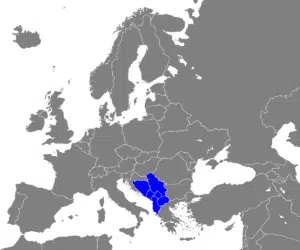
Image Source: Wikimedia Commons
This article was originally published in CeSPI Balkan Focus. For more information: https://www.cespi.it/en/focus-balcani
Written by: Sava Mitrovic, Associate at CEP Belgrade
Introduction
The Western Balkans (WB) have long benefited from substantial U.S. development assistance, especially via the U.S. Agency for International Development (USAID). Between 2020 and 2024, the U.S. invested roughly $1.7 billion in the WB, supporting both governmental and civil society-led projects in areas ranging from human rights and media to energy efficiency.[1] Although some of the projects were funded by other American donors, such as the National Democratic Institute (NDI) and the International Republican Institute (IRI), the largest portion of U.S. development assistance to the WB was provided through the USAID. For instance, for USAID-backed projects active in 2024, Kosovo*, BIH, and Serbia collectively received over $300 million, placing them among the top ten global beneficiaries of USAID funding.[2]
This strong U.S. engagement, however, has entered a period of uncertainty. On 20 January 2025, President Donald Trump signed a decree ordering a 90-day pause in U.S. foreign development assistance on the grounds that it is “not aligned with American interests and in many cases antithetical to American values.”[3] Furthermore, President Trump accused the “foreign aid industry and bureaucracy (…) of serving to destabilise world peace by promoting ideas in foreign countries that are directly inverse to harmonious and stable relations internal to and among countries.” The decision, which effectively is a sweeping cut-off of American development assistance, sent shockwaves through aid-dependent communities worldwide. The Western Balkans is no exception.[4]
In that regard, this paper analyses how the USAID funding cuts affect the democratic transformation of the region and consequently impact its EU accession efforts. The first section discusses how the suspension of aid affects and may further affect the functioning of democratic institutions and processes in the WB. The second section examines the implications for the EU enlargement process, considering that democratic backsliding in the region could stall or reverse progress toward EU membership. A final section offers a set of recommendations for European stakeholders, including EU institutions, member states, WB governments, and civil society, on how to mitigate the damage and safeguard democratic gains.
USAID Cuts and the Western Balkans’ Democratic Fabric
The freeze in U.S. aid has had an immediate and disruptive impact on the civil society-led initiatives aimed at strengthening the rule of law and democratic governance across the region. Taking into account that USAID programmes in the WB have been crucial in fostering transparent governance, anti-corruption efforts, independent media, and citizen engagement, it was to be expected that the suspension of this funding would have widely felt consequences.[5] Overnight, many of these essential projects were put on hold or cancelled, creating “shockwaves” across the region.[6] Throughout the WB, NGOs have reported having to suspend programmes, lay off staff, and scale back activities due to the sudden loss of funding. In Serbia alone, up to $80 million in funding for civil society has been frozen, hitting groups from LGBTQ+ rights advocates to anti-corruption watchdogs, with the National Youth Council losing one-third of its budget.[7] Similarly, in North Macedonia, at least 10 NGOs and youth organisations have lost over half of their funding, with approximately $72 million across 22 projects being suspended.[8]
The longer-term concern is that prolonged loss of support could severely hamper already fragile WB’s democratic fabric. Knowing that affected organisations have been vital partners in building democracy and nurturing liberal values, disrupting their work poses a serious challenge to democratic processes in the transitioning societies of the WB. Educating citizens, advocating for marginalised communities, monitoring reform processes, and holding authorities accountable are only some of the activities these organisations have carried out with USAID’s support, and whose sustainability is now at risk. Weakening civil society, especially in the context of insufficiently strong regulatory and oversight bodies, could disrupt the balance of power and further undermine checks and balances mechanisms. “Without an active civil society, democracy becomes an empty shell, vulnerable to the relentless erosion of freedoms,” a coalition of European NGOs wrote, noting that formal institutions alone cannot safeguard democracy if civic actors are silenced.[9]
Beyond the financial damage, the USAID cuts have triggered a political backlash against liberal organisations and activists, creating fertile ground for right-wing and nationalist actors to intensify their attacks and hostile narratives. Illiberal politicians in the region have seized upon the U.S. aid freeze to further discredit NGOs and independent media as agents of foreign influence. In recent months, aggressive smear campaigns have been launched, with several political actors, supported by aligned media outlets and public figures, seizing upon Trump’s decision to amplify long-standing narratives portraying CSOs as “corrupt, partisan, and driven by foreign agendas.”[10] Moreover, initiatives promoting liberal values have now been labelled as a “threat to national identity and traditional values.” Projects previously supported by USAID, in particular those advocating LGBTQ+, minority or women’s rights, are now dismissed as “fraud”, while organisations working on these issues were accused of “endangering the constitutional order”, effectively painting civil activists as enemies of the state.[11] Thus, the aid cuts have not only withdrawn resources but have also undermined the perception of civil society, reducing public trust in pro-democracy groups and branding them as “foreign agents.”
Spotlight: Serbia’s Government Exploits Trump’s Decision
One stark example of this backlash is seen in Serbia, where authorities have capitalised on the U.S. aid freeze to justify crackdowns on independent groups. Even though Serbia’s President previously praised USAID projects, which made the country “more beautiful and richer”, following Trump’s decision, this rhetoric has taken a complete turn, and USAID was accused of financing a “coloured revolution” in Serbia.[12] Furthermore, in late February 2025, Serbian police carried out raids on several prominent CSOs known for critiquing the government, over suspicions of alleged illegal spending of funds received from the USAID.[13] These actions came in the middle of the student-led protests and were the culmination of a wider campaign linking local NGOs to an alleged foreign plot. Serbian officials amplified reports, originating from the U.S. administration itself, about how much USAID had spent in the Balkans, “shoving” these figures into a narrative of foreign meddling and attempted overthrow of the state.[14] Two particular USAID-backed projects in Serbia were singled out by U.S. authorities as examples of “wasteful spending” on ideologically unwelcome causes, giving Belgrade’s regime further ammunition to attack organisations implementing these projects. Overall, the rhetoric of “foreign financing” has been wielded to cast any liberal or human rights advocacy as suspect.
The resulting climate is one of fear and vilification. Organisations that have long partnered with USAID on reforms, from anti-corruption training to fostering inclusive education, find themselves branded as traitors in tabloids. Activists report a surge in online abuse and even threats, echoing the language of the “foreign agent” label. The Serbian case illustrates how the U.S. retreat has not only removed democratic support but also actively empowered illiberal forces to tighten their grip. By weaponising the aid cuts in domestic propaganda, Serbian authorities are undermining independent civil society voices and entrenching a narrative hostile to democratic values. This poses a serious challenge: even if alternative funding is found in the future, rebuilding public trust in civil society in such an environment will be an uphill battle.
Implications for the EU Enlargement Process
The EU’s enlargement process is fundamentally conditional on candidate countries upholding the rule of law and proper functioning of democratic institutions and processes – the core Copenhagen criteria for EU membership. If fundamental reforms stall or reverse, the path to EU accession inevitably slows. Consequently, the risk of democratic and rule of law backsliding triggered by the USAID cuts carries direct implications for the WB’s EU membership aspirations. In that regard, observers warn that the abrupt removal of U.S. support, if not addressed, can lead to stagnation in the EU accession process for the WB.[15] The logic is straightforward: without external technical and financial assistance, many reforms, ranging from judiciary and governance upgrades to anti-corruption measures, may grind to a halt, undermining the countries’ ability to meet EU membership requirements.
Early signs of this are already visible. Key judicial efficiency projects and public administration reforms, once accelerated by USAID expertise, have lost momentum. In Bosnia and Herzegovina, for example, media reports confirm that numerous media and civil society projects had to be suspended after the aid freeze, undermining efforts to strengthen independent media and local governance there.[16] Another implication is the diminished oversight and accountability in the region, which can feed into a vicious circle of stabilitocracy. In other words, with many of “democracy’s watchdogs” now financially crippled, there is a risk that authoritarian tendencies go unchecked under the radar. Likewise, if civil society groups that used to promote European values are silenced, local populations may be more susceptible to Eurosceptic or authoritarian messaging. In summary, the suspension of USAID funding in the Western Balkans is not just a development policy issue. It is a strategic setback for the region’s European future, which, by weakening the drivers of reform on the ground, slows progress towards EU membership.
Conclusions and Policy Recommendations for European Stakeholders
The fate of democracy in the WB is deeply intertwined with EU enlargement. At the same time, the EU has long relied on transatlantic complementarity, meaning the U.S. political and financial backing was crucial for candidate countries’ reform processes on their European path. Therefore, the USAID cuts pose a double challenge: they weaken reformers on the ground and create a political vacuum that external rivals might exploit. The prospect of sustained U.S. funding gaps means the EU may have to adjust its strategy. With a less reliable transatlantic partner, the Union “must double down on its efforts” and “assume greater leadership in the region”.[17]
In light of these developments, researchers have already noted that there is an urgent need for European stakeholders to step up and safeguard democracy in the Western Balkans.[18] The following policy recommendations are addressed to various actors – the EU institutions, EU member states, Western Balkan governments, and civil society – who each have a role to play in mitigating the impact of the USAID funding cuts and keeping the region’s EU integration on track.
- EU Institutions (European Commission and EU Delegations): Establish emergency support mechanisms for democracy and civil society in affected countries. The European Commission should create bridge funding arrangements or a special democracy support fund to provide fast grants to at-risk NGOs and independent media in the Western Balkans. This could involve reallocating a portion of unspent IPA funds or using the European Endowment for Democracy to channel urgent support. The Commission should also ease co-financing requirements and bureaucratic hurdles for EU grants in this field. This means temporarily allowing 100% EU funding for key civil society projects, simplifying application procedures, and accelerating disbursements.
- EU Member States: Redouble bilateral support and diplomatic engagement for democracy in the WB. Member states, especially those who traditionally champion enlargement, such as Germany, Sweden, or the Visegrad countries, should respond to this crisis by increasing their own democracy assistance to the region, filling some of the gap left by USAID. Even small grants for community-level initiatives can make a difference in sustaining NGOs through this period. At the highest political level, EU governments must also treat civic space and democratic standards as a priority issue in their dealings with Western Balkan leaders. European governments should make clear that undermining civil society or media freedom will carry consequences for bilateral relations and EU accession prospects.
- Western Balkans Governments: The governments of the WB should recognise that safeguarding democracy is ultimately in their own interest for EU accession and regional stability. Firstly, authorities must cease any harassment or smearing of civil society actors. Rather than exploiting the situation to clamp down, governments should publicly acknowledge the legitimate role of NGOs, activists, and independent media as partners in development and the EU accession process. Secondly, WB governments ought to allocate domestic resources to critical reform areas previously supported by donors. For example, if a USAID-backed judicial training program or anti-corruption task force has lost funding, the national budget (with possible aid from the EU or others) should try to keep it running. These steps signal that democracy is not merely donor-driven but locally owned.
- Civil Society: Adapt, cooperate, and find innovative ways to sustain the democratic ecosystem. Civil society in the Western Balkans, though under severe strain, is not completely without agency. CSOs in the region should intensify their coordination and solidarity networks – sharing resources where possible and presenting a united front in advocacy. Regional networks can help pool knowledge on alternative funding sources and provide support against smear campaigns. CSOs should jointly engage more in public communication, countering the disinformation.
The Western Balkans stands at a delicate point. Just as the EU has signalled a renewed commitment to enlargement, the withdrawal of U.S. support has left the region’s democratic reformers vulnerable and severely constrained in their efforts. Whether this will result in a democratic backsliding or a catalyst for greater European ownership of reform processes in the region will depend on the response from key European stakeholders. If European institutions, member states, and other donors act swiftly and decisively, they can prevent a rollback of democratic gains and keep the dynamism of WB’s reform processes. That means filling (at least partially) the financing gap, but also upping the political ante – making clear that democracy and civic space are non-negotiable elements of European integration. The financial cost of such action is modest when set against the far greater strategic risk of democratic backsliding in the Western Balkans and the prospect of the region drifting into the orbit of malign geopolitical actors.
[1] Balkan Insight, “Trump’s Suspension of US Foreign Aid Hits Hundreds of Balkan Projects”, 30 January 2025, https://balkaninsight.com/2025/01/30/trumps-suspension-of-us-foreign-aid-hits-hundreds-of-balkan-projects/.
[2] Lirim Krasniqi, “US Foreign Aid Suspension: Reshaping the Future of Kosovo’s Civil Society”, Pristina Insight, 14 February 2025, https://prishtinainsight.com/us-foreign-aid-suspension-reshaping-the-future-of-kosovos-civil-society-mag/#:~:text=The%20six%20Western%20Balkan%20countries,and%20media%20to%20energy%20efficiency.
[3] The White House, “Presidential Actions: Reevaluating and Realigning United States Foreign Aid”, 20 January 2025, https://www.whitehouse.gov/presidential-actions/2025/01/reevaluating-and-realigning-united-states-foreign-aid/.
[4] While every country in the Western Balkans has benefited considerably from USAID’s development programs, with Kosovo* and BIH being the primary beneficiaries, the repercussions of a funding cut do not seem to be uniform, as national contexts and approaches to donor transition vary widely.
[5] Balkan Civil Society Development Network, “Fallout of the US Funding Freeze Puts Western Balkans Civil Society Under Attack”, 14 February 2025, https://balkancsd.net/fallout-of-the-us-funding-freeze-puts-western-balkans-civil-society-under-attack/.
[6] Balkan Civil Society Development Network, “POINT 13 – Civil Society in the Western Balkans: Navigating a Shrinking Space Amid Funding Freezes and Shifting EU Priorities”, 2 June 2025, https://balkancsd.net/point-13-civil-society-in-the-western-balkans-navigating-a-shrinking-space-amid-funding-freezes-and-shifting-eu-priorities/.
[7] Rareș Voicu, “Last Chance for the EU in the Western Balkans”, European Youth Forum, 14 February 2025, https://www.youthforum.org/news/last-chance-for-the-eu-in-the-western-balkans.
[8] Ibid.
[9] European Prison Litigation Network, “Op-ed: Europe Must Act to Safeguard Civil Society Amid USAID Funding Freeze”, 10 March 2025, https://www.prisonlitigation.org/articles/op-ed-usaid-impact-civil-society/#:~:text=also%20depends%20on%20the%20existence,can%20prevent%20such%20a%20decline.
[10] Balkan Civil Society Development Network, “Fallout of the US Funding Freeze Puts Western Balkans Civil Society Under Attack”, Op. cit.
[11] Yza Schraal, “The impact of U.S. Foreign Aid Cuts in the Western Balkans“, European Forum for Democracy and Solidarity, 7 May 2025, https://europeanforum.net/the-impact-of-u-s-foreign-aid-cuts-in-the-western-balkans/#:~:text=The%20cutting%20of%20USAID%20also,Speaking%20to%20a%20source%2C%20it.
[12] Marija Stojanović, “USAID makes Serbia more beautiful and richer”: How Serbian officials used to talk about what they now call a “notorious organisation”?, European Western Balkans, 28 February 2025, https://europeanwesternbalkans.com/2025/02/28/usaid-makes-serbia-more-beautiful-and-richer-how-serbian-officials-used-to-talk-about-what-they-now-call-a-notorious-organisation/#:~:text=In%202021%2C%20when%20USAID%20celebrated,country%E2%80%99s%20economic%20and%20democratic%20development.
[13] Civil Rights Defender, “Serbian police crack down on civil society organisations“, 27 February 2025, https://crd.org/2025/02/27/serbian-police-crack-down-on-civil-society-organisations/.
[14] Aleksandar Ivković, “Serbian authorities are artificially constructing narratives about the overthrow of the state through USAID“, European Western Balkans, 1 March 2025, https://europeanwesternbalkans.com/2025/03/01/serbian-authorities-are-artificially-constructing-narratives-about-the-overthrow-of-the-state-through-usaid/#:~:text=dismantling%20of%20USAID%20into%20Serbia%E2%80%99s,efforts%20to%20overthrow%20the%20government.
[15] Yza Schraal, “The impact of U.S. Foreign Aid Cuts in the Western Balkans“, Op. cit.
[16] Darko Kurić, “USAID suspension in BiH, a hard blow to media and civil society”, OBCT, 18 February 2025, https://www.balcanicaucaso.org/en/cp_article/usaid-suspension-in-bih-a-hard-blow-to-media-and-civil-society/#:~:text=USAID%20suspension%20in%20BiH%2C%20a,that%20were%20previously%20supported.
[17] Bojana Zorić, “Testing Continuity: The Western Balkans at the margins of transatlantic (dis)engagement”, in: Low Trust: Navigating transatlantic relations under Trump 2.0, edited by Giuseppe Spatafora, Steven Everts and Alice Ekman), European Union Institute for Security Studies, Chaillot Paper 187, October 2025, p. 64, https://www.iss.europa.eu/sites/default/files/2025-10/CP_187_0.pdf.
[18] Sarah Repucci and Zselyke Csaky, “Filling the USAID Gap: How Europe Can Step Up to Support Democracy”, European Democracy Hub, 11 March 2025, https://europeandemocracyhub.epd.eu/filling-the-usaid-gap/.